When choosing garden statues for UK outdoor spaces, deer ornaments consistently rank among the most impactful options. Whether you’re considering a life-size stag statue, a graceful doe, or a complete deer set for your garden, these pieces bring scale, elegance, and year-round presence to any landscape.
Life-size deer garden statues work across traditional cottage gardens, contemporary landscapes, and woodland settings. They create focal points that change how you experience outdoor space. But with options ranging from standing stags to leaping deer pairs, choosing the right piece requires understanding your space, placement options, and the practical differences between styles and materials.
Why Deer Garden Statues Work So Well in UK Gardens
Deer ornaments tap into something primal. They’re elegant without being fussy, commanding without overwhelming a space, and they adapt to different garden styles better than most animal statues.
Scale drives much of their appeal. A life-size deer statue creates genuine presence. It becomes a focal point that influences sight lines, planting decisions, and how you move through the garden. The form itself is sculptural enough to hold its own in both naturalistic and formal settings.
Browse our full collection of deer garden statues
Types of Deer Garden Statues (And When to Use Each)
Standing Stags
The classic choice for deer garden ornaments. A stag in a standing pose, head raised, often with a full rack of antlers, works best when you want to create height and draw the eye upward. Position these where they can be seen from a distance – at the end of a pathway, against a backdrop of evergreens, or on a slight elevation where the silhouette registers clearly.
Stag and doe sets create natural pairings, with the standing stag providing height while the doe offers a gentler counterpoint.
Leaping or Rearing Deer
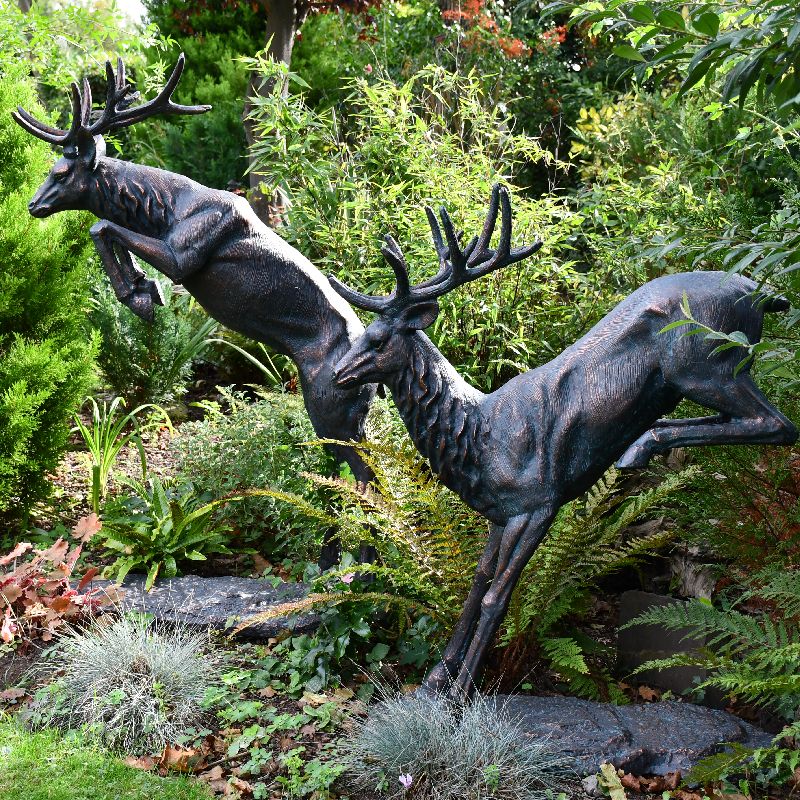
Dynamic pieces that capture movement. A leaping stag introduces energy to a space and works particularly well in larger gardens where the piece has room to breathe. These are effective when positioned to appear as though they’re jumping over or between planting beds.
The leaping stag and landing stag pair creates a sense of narrative and movement that static pieces can’t match – one deer frozen mid-leap, the other touching down.
Grazing Does and Fawns
Gentler in tone, pieces like standing stag and grazing doe pairs bring softer presence to gardens. Does and fawns work well in more intimate spaces or near seating areas where you want something contemplative rather than commanding. They suit cottage gardens and naturalistic planting schemes particularly well.
Stylised vs Realistic
Realistic deer statues aim for anatomical accuracy and lifelike detail. They work when you want the piece to blend into the landscape and create that double-take moment of “is that real?”
Stylised or abstract deer lean into form and silhouette. They’re often more sculptural, sometimes simplified or exaggerated for effect. These suit contemporary gardens or spaces where you want the ornament to be clearly decorative rather than attempting realism.
Choosing the Right Material for Garden Deer Statues
Most deer garden ornaments are made from cast aluminium, resin, fibreglass, or cast stone. Material choice affects appearance, maintenance, and longevity.
Cast aluminium (what most of our collection uses) is lightweight, durable, and weather-resistant. Recycled aluminium pieces won’t rust or corrode in British weather, and they can be finished with aged verde or bronze patinas that develop character over time. The material allows for fine detail while remaining practical for UK gardens.
Resin and fibreglass offer lighter weight and typically lower prices. They’re easier to reposition and can capture fine detail, but cheaper versions may look synthetic up close and don’t weather as attractively.
Cast stone or concrete brings weight and permanence. These develop patina and moss naturally, which can improve appearance over time. The trade-off is weight (difficult to move) and usually higher cost.
For UK gardens, quality cast aluminium or resin works well provided the piece has good surface finishing. Cast stone suits permanent installations where natural weathering is part of the appeal.
Life-Size Deer Statues: Getting the Scale Right
“Life-size” means different things depending on the deer species. A mature red deer stag can reach 120-140cm at the shoulder, which translates to substantial presence in most domestic gardens.
Before committing to a life-size deer statue, consider:
- Sightlines from inside: Will you see it from main living spaces? Does it work at that scale indoors?
- Proportion to planting: A full-scale stag can dwarf immature border planting
- Pathway clearance: Does it narrow walkways uncomfortably?
In many cases, three-quarter scale pieces (90-110cm) give you impact without overwhelming typical suburban gardens. You retain presence while maintaining better proportions with standard fence heights and planting beds.
Where to Position Your Deer Statue
Terminal focal points
The end of a path, the back corner of a lawn, the centre point at the rear of a border. These are classic positions because they pull the eye through the space and create depth. A deer statue works particularly well here because the form is strong enough to register from a distance.
Framed by planting
Position the statue where it’s partially screened by taller planting – grasses, shrubs, or perennials that grow up around it. This creates that “discovered” quality rather than placing it front and centre. The statue becomes something you come across rather than something you’re shown.
This works especially well with does or fawns where you want a more naturalistic effect.
Silhouetted against structure
A deer statue positioned against a dark fence, hedge, or wall creates strong visual contrast. This is where the silhouette becomes important – you’re essentially creating a three-dimensional shadow. It works best with pieces that have clear, readable outlines: antlers, raised heads, leaping poses.
In pairs or groupings
Two deer positioned at different heights or angles can create more interest than a single piece. A leaping stag and a landing stag suggest movement. A doe and fawn together bring a narrative quality.
Avoid symmetry unless you’re working in a formal space. Slightly offset positioning, different angles, or varied heights tend to look more natural and less staged.
Common Placement Mistakes to Avoid
Too close to buildings: Deer are woodland creatures. Positioned right against a house, they look trapped. Give them breathing room.
Ignoring surrounding scale: A life-size stag next to a metre-high fence creates awkward proportions.
Over-lighting: Subtle uplighting or backlighting works better than floodlighting. The silhouette is strong enough without announcement.
Deep hiding in planting: Unless deliberately creating a hidden surprise, this diminishes the impact you’ve invested in.
Maintenance and Weathering
Cast aluminium and resin deer need minimal maintenance. Occasional hosing removes surface dirt, and a soft brush handles algae buildup. Most are UV-resistant, though long-term sun exposure can fade painted finishes in full south-facing positions.
Cast stone pieces weather naturally. Moss and lichen growth gives aged character. To accelerate this, coat with natural yoghurt or moss growth product. For cleaning, a stiff brush and water suffices. Both materials handle UK frost when properly manufactured.
Styling Around Your Deer Ornament
Planting determines how successfully the statue integrates.
Naturalistic approach: Use grasses and meadow-style planting. Stipa, Miscanthus, and Panicum create movement and partial screening that complements deer forms. Avoid formal or structured plants.
Contemporary setting: Keep planting minimal and architectural. Clipped box, structural evergreens, or gravel and stone. Let the deer be the organic element against controlled surroundings.
Seasonal interest helps – spring bulbs, summer perennials, autumn colour give the statue different contexts through the year.
How Many Is Too Many?
There’s no fixed rule, but restraint usually wins. One substantial deer statue creates impact. Three or four positioned through a garden can work if the scale is right and the space is large enough.
Beyond that, you’re moving into deer park territory, which is a deliberate aesthetic choice that needs commitment. In most domestic settings, one or two well-placed pieces will do more than a collection.
Finding the Right Deer Statue
Quality varies significantly. Look for:
- Clean casting with good detail in features (eyes, antlers, hooves)
- Smooth finishing without visible seam lines or rough edges
- Realistic proportions and posture (badly proportioned deer look wrong even if you can’t immediately identify why)
- Appropriate weight for the material (cheap resin pieces are often noticeably light and flimsy)
- Weather-resistant finishes designed for year-round outdoor placement
Prices range from under £100 for small decorative pieces to several hundred pounds for life-size, high-quality statues. It’s worth paying for better quality if this is going to be a focal point in your garden – cheaper pieces tend to look cheap, and they’re what you’ll see every day.
Final Thoughts
Deer garden ornaments work because they bring scale, form, and a touch of the natural world into outdoor spaces. They’re not subtle, but they’re not meant to be. A well-chosen deer statue becomes part of how you experience your garden – a fixed point that everything else moves around.
The key is choosing the right piece for your space, positioning it where it can do its job, and not overthinking it. Trust your instinct on placement, give it room to breathe, and let the piece settle into its surroundings.
Looking for the perfect deer statue for your garden? Browse our full collection of life-size deer garden ornaments and garden statues that bring genuine presence to outdoor spaces.